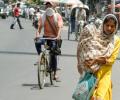
North India is experiencing an intense heatwave, with temperatures soaring to 48 degrees Celsius in some areas. Several states have issued warnings and advisories as the heatwave is expected to continue.

Punjab and Haryana are experiencing severe heatwave conditions, with temperatures soaring several notches above normal. Bathinda recorded the highest temperature at 46.2 degrees Celsius, while Rohtak reached 44.5 degrees Celsius, impacting daily life across the region.

Most north Indian states reported below-normal temperatures on Monday, with rain and thunderstorms lashing parts of Uttar Pradesh, Rajasthan, and Himachal Pradesh. The southwest monsoon is expected to arrive in Kerala in the next two to three days.

Many places across northern states including Delhi recorded above-normal temperatures crossing 40 degrees Celsius, while the India Meteorological Department warned of heatwave conditions in parts of Uttar Pradesh in the coming days. Jammu and Kashmir saw a dip in temperatures with fresh snowfall in the higher reaches and rainfall in the plains.

Northern states in India are experiencing severe heatwave conditions, with temperatures reaching up to 46.6 degrees Celsius. The heatwave has impacted daily life, leading to a decline in tourism and increased power demand. Authorities have issued advisories and implemented measures to mitigate the effects of the extreme heat.

A new western disturbance brought thunderstorms and rain to parts of northern India, with hailstorms and snow reported in several regions. The weather caused flooding in Jammu and Kashmir and prompted a yellow alert in Delhi.

A severe cold wave has gripped North India, with temperatures plummeting to near-freezing levels in several areas. The cold wave has disrupted daily life, with dense fog affecting visibility and forcing people to stay indoors.

A severe cold wave has intensified across North India, with Delhi recording its lowest temperature of the season. Rajasthan experienced sub-zero temperatures, and several states have issued alerts and closed schools due to the extreme conditions.

A 5.9 magnitude earthquake with its epicentre in Afghanistan jolted several parts of north India, including Delhi, Jammu and Kashmir, Punjab, and Haryana, on Friday night. While tremors were felt, no immediate reports of damage or casualties have emerged.

Work has commenced on restoring the North and South Blocks to their original design, paving the way for the Yuge Yugeen Bharat National Museum project, with a target completion date for the first phase set for 2028.

Delhi recorded its coldest January morning in three years with the minimum temperature dropping to 3 degrees Celsius. Cold wave conditions are expected to persist, and air quality has deteriorated to the 'very poor' category.

The Recipe for a North Indian yoghurt-chawal.

The Airports Authority of India (AAI) on Monday issued a travel advisory as dense fog gripped Northern India, urging passengers to check their flight status before leaving for the airport to avoid prolonged waiting periods at the airport in case of flight cancellations or delays.

Several states in north India, including Rajasthan and Himachal Pradesh, experienced varied weather conditions, including light to moderate rainfall, fog, and temperature fluctuations.

Several parts of India are experiencing a severe heatwave, with temperatures soaring past 44 degrees Celsius. States are issuing alerts and taking measures to protect people and animals from the extreme conditions.

Dense winter fog and smog have gripped several Indian cities, from Agra's Taj Mahal to the streets of New Delhi, Srinagar, Lucknow, and beyond. These chilling visuals capture how residents, commuters, and tourists are coping with poor visibility and biting cold. From washermen on the Gomti riverbank to Shikara rides in Dal Lake, the photographs highlight the impact of extreme weather on daily life across northern India.

The IMD is predicting close to a 60% probability of deficient rainfall, which means there is a strong possibility that the monsoon this year will be poor.

India begin their 2026 Test season against Afghanistan with several selection questions to answer, including the No. 3 spot and Ravindra Jadeja's long-term successor, as they build towards key World Test Championship assignments.
India's Avani Prashanth faced a challenging third round at the 2026 Amundi German Masters, carding an 81 and slipping down the leaderboard. Despite a strong recovery in the second round, difficult weather conditions impacted her performance.

Large parts of India are experiencing a severe heatwave, with temperatures soaring to dangerous levels. Authorities have issued alerts and health advisories as the heatwave intensifies across multiple states.

'Can you believe there are over 26,500 deaths linked to heatwave-driven ozone in 2024?'

Unseasonal rainfall could damage standing wheat crops, especially late-sown fields nearing maturity and grain-filling stages.

The EC also underlined that for electors whose enumeration forms have not returned, the Booth Level Officers (BLOs) would identify a probable cause, such as absent, shifted, dead and duplicate entry based on an inquiry from the nearby electors and would note the same.

'We should expect extreme heat, extreme rains, floods, landslides and maybe cyclones. Not just this year, in the coming year as well.'
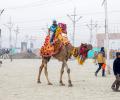
Residents of North India battle freezing conditions.

A poor monsoon could drag overall economic growth and compound the impact of the West Asia conflict on the Indian economy.

'All this diversity that our country provides brings in a lot of learnings.' 'That is what I really end up sharing with the whole community.' 'But it all comes through making my shoes dirty.'

Dabur India's stock has fallen over 17 per cent since the start of the Iran war, driven by concerns over a weak monsoon, the West Asian crisis, and rising input costs, which are expected to impact the company's revenues and margins, particularly affecting its significant rural sales and international markets.

The Congress party's delay in naming the next Chief Minister of Kerala has drawn criticism, particularly from key ally IUML, which warns of potential political fallout from the prolonged uncertainty.

Researchers at IIT Bombay have discovered that heatwaves in the Indo-Gangetic Plains are primarily caused by local land and weather conditions, rather than hot air originating from elsewhere, emphasising the need for location-specific early warning systems.

Increased input costs due to geopolitical conflict in West Asia and unseasonal rain in March negatively impacted volumes of consumer durables makers, particularly air conditioners, in Q4FY26, leading to projected declines in EBITDA and APAT despite revenue growth.

'During the hot season (April to June), above-normal minimum temperatures are likely over most parts of the country, except in some regions of Maharashtra and Telangana, where minimum temperatures are expected to be normal to below normal,' IMD said.

A cold wave has intensified in most parts of north India, with temperatures in the Kashmir Valley dipping below freezing point. The national capital saw a brief respite from the bitter cold during the day, but cold conditions persisted in parts of Rajasthan and Himachal Pradesh. The weather department has issued a yellow warning for cold wave, ground frost and dense fog for some places in Himachal Pradesh. There is a possibility of rain and snowfall in parts of northwest India later in the week.

The electorate did not vote for the BJP as much as they voted against the TMC. This is an important distinction that the new government will ignore at its own peril, points out Vice Admiral Biswajit Dasgupta (retd).

Above-normal cold wave days are expected in some areas of central India, eastern Uttar Pradesh and Bihar during January 2026.

Experts warn that a new government definition of the Aravali Hills, accepted by the Supreme Court, could lead to environmental degradation and expose Delhi and surrounding regions to harsher weather and drought conditions.

We cannot simply have a 60-65 per cent import dependency in LPG, the bulk of which comes from just one volatile region -- West Asia, points out R Jagannathan.
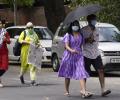
The India meteorological department said heatwave conditions will persist for at least two more days.

A three-hour heavy downpour accompanied by a dust storm hit Delhi-NCR early morning on Friday, causing flight delays and traffic disruptions as seven people were killed in rain-related incidents across north India.

Cold-day conditions prevailed in parts of north India on Friday though the maximum temperatures rose slightly amid clear skies and sunshine during the day.
